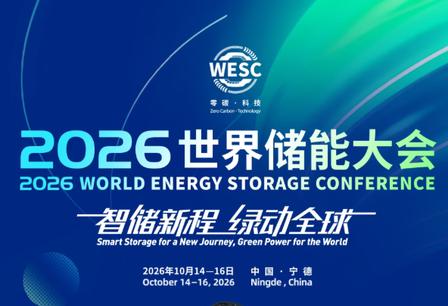
The 2026 World Energy Storage Conference, held in Ningde, closed with one signal that outweighs every individual data point: energy storage is being re-valued.
Not as a “solar add-on.” Not as a “peak-shaving tool.” But as the core infrastructure of the new power system — the one resource that can provide both power-type and energy-type regulation at scale, and therefore the one that can hold together high-renewable-penetration grids, AIDC compute demand and industrial electrification at the same time.
For anyone buying, building or distributing storage in 2026, this revaluation changes what products win, what metrics matter and who survives the coming consolidation.
Quick answer: what actually changed
- Storage’s identity jumped four levels — from follower to core support, from peak-shaving to multi-value, from grid-following to grid-forming, and from accessory to independent market participant.
- The race is no longer about installed GW — evaluation has shifted from “installation scale” to “operational value,” a change driven explicitly by China’s Ministry of Industry and Information Technology (MIIT) against “involution-style” competition.
- The winners will be system-solution providers and asset operators — not pure equipment sellers.
The numbers behind the revaluation
The conference released a set of figures that, taken together, show an industry moving past its growth phase and into a value-capture phase.
| Metric | 2026 figure | What it signals |
|---|---|---|
| H1 2026 energy storage battery output | ~420 GWh, up ~110% YoY | Demand is not cyclical — it has structurally doubled |
| New energy storage installed capacity | over 153 GW (50x the “14th Five-Year” start) | Scale has arrived; the question is now value, not volume |
| Independent storage share of new capacity | 69.3% | Storage now drives revenue as a market asset, not a plant attachment |
| 2025 effective utilization hours | 1,195 h, up ~300 h YoY | Independent assets have become high-frequency dispatch resources |
Rule of thumb: A storage asset is now judged the way a power plant is — by utilization hours, dispatch frequency and operational value, not by nameplate capacity alone.
The four identity jumps, unpacked
The conference framed storage’s trajectory through four transitions. Each one maps to a concrete shift in what buyers should look for.
- From follower to core support. Storage was once the “companion” to wind and solar. It is now the linchpin that makes high-renewable grids stable and dispatchable.
- From peak-shaving to multi-value. The revenue stack has expanded well beyond time-shifting to frequency regulation, capacity, reserve and ancillary services.
- From grid-following to grid-forming. This is the deepest technical shift — storage that can set voltage and frequency, not just follow the grid. Grid-forming capability is what turns storage into a true replacement for synchronous generation.
- From accessory to independent market participant. With independent storage at 69.3% of new capacity, storage is now its own asset class, traded and dispatched on its own economics.
From scale competition to value competition
The most consequential policy signal came from MIIT: prevent “involution-style” competition and move the industry from scale expansion to efficiency-driven growth.
This quietly rewrites the procurement rulebook:
- The old metric was nameplate GW. The new one is runtime value — how often the asset is called, and how reliably it delivers.
- The old winner was the cheapest box. The new winner is the system that earns the most over its life.
- Consolidation is accelerating. Companies that cannot move up the value chain — from equipment supply to system solutions and asset operation — will be squeezed out.
For a buyer, this means the spec sheet matters less than the total system design, and the lowest upfront price increasingly predicts the weakest long-term economics.
Where the technology is heading
The conference was explicit that no single chemistry wins everything. Lithium remains the backbone, but it is now part of a multi-track portfolio:
| Route | Role |
|---|---|
| Lithium-ion (LFP-led) | Mainstream: C&I and residential workhorse |
| Sodium-ion | Low-cost, lower-energy-density complement |
| Flow batteries | Long-duration, high-cycle stationary storage |
| Compressed-air | Utility-scale, multi-hour storage |
Two capabilities sit on top of whichever chemistry you choose:
- Grid-forming + AI dispatch turns storage from a passive responder into an active support resource — the direction every serious grid-scale product is now pointing.
- “Storage +” convergence pushes storage beyond the grid into zero-carbon factories, ship electrification and compute-power coordination (storage paired with AI data centers).
Key takeaways
- Storage is no longer an accessory — it is the core infrastructure of the new power system, and 2026 is the year that framing became official.
- Value, not volume, is the new battlefield — utilization hours and dispatch frequency now outrank installed capacity as success metrics.
- Grid-forming is the future-proof capability — it is what separates “a battery” from “a grid asset.”
- Buyers should select partners, not products — the winners are system-solution providers and asset operators who can deliver through the whole lifecycle.
FAQ
What is the 2026 World Energy Storage Conference? An industry conference held in Ningde, China, that has become the de-facto agenda-setter for the global energy storage industry’s policy direction, technology roadmap and market logic.
What does “storage’s value revaluation” mean? It means storage’s role is being re-priced and re-classified — from a passive accessory to wind and solar, to core infrastructure whose worth is measured by operational value and dispatch, not installed capacity.
What is grid-forming storage? Storage equipped to set and stabilize grid voltage and frequency on its own, rather than simply following the grid — allowing it to replace synchronous generation and support weak or islanded grids.
Why is independent storage growing so fast? Because storage is now economically viable as a standalone market asset — at 69.3% of new capacity, it generates revenue through dispatch and ancillary services rather than existing only to support a power plant.
What should a buyer look for after this shift? A supplier who designs for operational value (utilization, dispatch, grid-forming capability) and can support the full lifecycle as a system-solution provider and asset operator — not the lowest upfront price.
Tracking the 2026 storage shift? FUJI Energy supplies grid-forming-capable C&I and residential energy storage, with OEM/ODM and system-integration support — built for operational value, not just nameplate capacity. Talk to our engineering team or explore energy storage products.
Leave a comment